 By Shome Basu
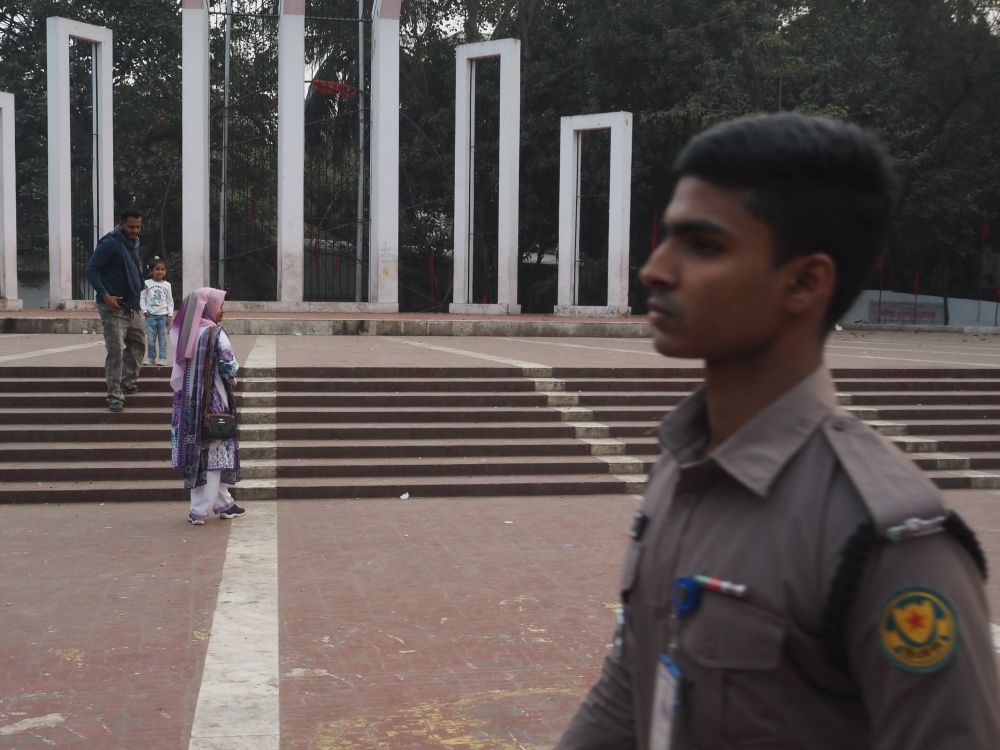
The Shahid Minar, the Martyrs’ Monument in the Dhaka University area, always reminds visitors of its existence. Yes, of the martyrs of 21st February and the advent of Bengali language identity. Yes, Dhaka city’s square reminds every Bangladeshi of its existence, and now the world recognizes it.
Every protest from nearby TSC Square, Shahbagh, poet Kazi Nazrul Islam’s samadhi, and the university keeps the idea of Bangladesh and its language vibrant.
The first Shaheed Minar was built immediately after the events of 21 and 22 February 1952. According to Dr Sayeed Haider, the main planner and designer of the first Shaheed Minar, the decision to build it was first made by the students of Dhaka Medical College. The Shaheed Minar is situated near Dhaka Medical College Hospital in the Dhaka University area.
In 2016, after I posted an image on social media from the Schengen area, where the EU declaration was signed, there was a spinning wheel on which the word peace was written in many world languages. I was happy to see Hindi being one of them. My friend from Dhaka saw the image and instantly called me and asked, “Didn’t you see the Bengali script?” I said, “Sadly, no.” The next question was, “Urdu?” I said, “No.” He sighed and said, “Well, we don’t want to demean Urdu, but Bengali is as equal as the other languages.” I understood the deep sentiment hidden in his words and, as a Bengali, could relate to the pain and anxiety. To understand this, we have to step back to the time when the Dominion of Pakistan was carved out by Sir Cyril Radcliffe in 1947 and how Urdu speaking domination gave rise to Bengali nationalism. Urdu and Bengali were separated by 4000 km, with India in between.
Mohammed Ali Jinnah, the supremo of the newly formed country Pakistan with Dominion status, visited its Eastern Wing, East Pakistan, on 18th March 1948. That was the first and last time the Governor General visited East Pakistan’s Dacca, as it was called then. Still smoking and coughing up blood, Jinnah, fondly called Quaid e Azam, was in a serious health condition as his lungs were failing. A few days later, on 21st March evening, as the sun was setting, Jinnah stood among the people of East Pakistan at the filled Race Course Maidan, breathing heavily.
“Urdu would be Pakistan’s only national language.” The microphones carried the feeble voice of the Quaid and, after a sudden silence, a barrage of “No, no, no” came from the crowd.
A few days later, on March 24th 1948, students at Dhaka University received Governor General Jinnah. There too he reiterated that regional areas might have their own languages, but the national language of Pakistan would remain Urdu. Again, a barrage of rejection followed. Among many students, Abdul Matin was seen to be emotional and proactive in challenging the Father of the Nation. Thus the Language Movement took a new turn.
Months before this happened in Dacca, another Bengali, Dhirendranath Dutta, proclaimed that “The national language should be the language spoken by the majority of the people of the country, and I think that Bangla should be the lingua franca of our country.” Dutta was making his point at the Constituent Assembly of the Dominion of Pakistan. He believed the majority’s language should be the widely spoken language and should be given national importance. Liaquat Ali understood his will, but the looming politics from West Pakistan saw it as Bengali hegemony, as politics was mostly controlled from the West.
Although there was no immediate effect on the Bengali population, it sowed the seeds when students rebuffed Quaid e Azam during his only visit to Dhaka a few months later. This accelerated the progress of what is famously known as the Language Movement.
As the years passed, none of the provincial heads or so called prime ministers from East Pakistan, all being Bengali, could promote the idea of linguistic superiority. Be it Mohammed Ali Bogra or Nurul Amin, none could convince the West Pakistan power structure.
With the approach of the 1950s, the agitation changed. Student protests claimed Bengali as the national or first language. Eminent scholar from Dhaka on the Bengali Language Movement, Asjadul Kibria, has often cited the looming storm of the movement which was one day bound to break as a revolution. In his book Bhasha Andoloner Golpo, he describes in a chapter titled Batashe Ekusher Ghran the air filled with the smell of twenty first February. There he describes how students from Chittagong to Dhaka prepared to stand against West Pakistan’s decision. Over dinner in Dhaka, when Asjadul and I spoke about the media’s role during that movement, it was even more striking. Dailies like Ittafaq, Insaf, and Naye Bellal supported the language movement. More interestingly, Insaf, which leaned towards the West Pakistan government, also supported it. However, the English dailies like The Morning News and The Pakistan Observer were critical of the language movement. Although The Dawn, which was then printed from Lahore, had a critical viewpoint, after 21st February it supported the movement by mentioning it in one of its op ed pages.
Coming to 21st February, all was set to table the East Pakistan budget at the Assembly. The Members of the National Assembly gathered. Dhaka city was under Section 144 of the CrPC, under which more than four people together or any agitating crowd would be arrested without any warrant. The police presence was heavy, especially around Dhaka University and further towards the Assembly. Even the Paltan Maidan and Ramna Race Course areas were under strict police watch. The administration knew the fire was brewing.
Proponents of the language movement, like Abdul Matin, Ghulam Maula, and Ali Ahmad were meanwhile in the university canteen planning how to break Section 144.
On that fateful Thursday, students rallied in small groups of ten, starting from where today stands the Dhaka Medical College, which back then was the Arts Faculty. With the spring breeze and the soaring heat of the day, slogan chanting students gathered around noon. Habibur Rahman, Shelly, Ajmal Hossain, and Safia Khatoon were the leaders who mobilized the students towards the police picket. An uncontrollable crowd faced the police, compelling them to fire tear gas canisters. From the students’ side, stones were hurled at the police, while many broke away to march towards the Assembly where the budget was to be tabled. The police used batons and, in handling the riot, took over the campus and beat students mercilessly, irrespective of gender, but retreated without making arrests.
The protests spread within two kilometers of the university area. Even an MNA, a minister of Pakistan, Hossain Ali, had his car surrounded and stoned until the police rescued him. All continued till 3 PM, when .303 rifles were brought out. Rafiquddin Ahmad’s skull was shattered, his head split open, exposing the grey matter. The bullet broke it into pieces, and Rafiq became the first martyr of the Language Movement. Today, what we see in Dhaka as Shahid Minar is the place where most fell to establish their mother tongue, Bengali, as their language of communication.
There was no Awami League or any Jamaat. It was simply a student movement to assert their freedom to use and uphold their linguistic authority in the West Pakistan dominated political structure 4000 km away, where the Bengali-speaking eastern wing was a victim. The movement was successful, and by 1956 the Pakistani government recognized Bengali as an official state language.
The Muslim League amended the Constitution to place Bengali as a state language to be officially used. Even today, any scripture in Bangladesh is only in Bengali, and people remain deeply sentimental about the language and its capabilities. A driver in Dhaka who took me around comfortably later messaged me in Bengali script. When I asked him about speaking Urdu, he smiled and said that a few words like pani and izzat are used, but not much. He said, “We have no problem with Pakistan as long as they respect our language and identity. Otherwise, religion wise we are brothers.”
With 8000 regional languages, UNESCO in 1999 took the initiative to recognize this day as International Mother Language Day, giving special status to Ekushe February. “Amar bhaier rokte ranga ekushe February, ami ki bhulte pari” written by Abdul Gaffar Chowdhury in 1952 is still a song heard by many Bengalis today, whether in Dhaka or abroad. With their language, Bengalis remain a very independent people, which they showed in 1971 and again in August 2024. For them, freedom is nothing less than absolute.
Today, Shahid Minar, where students fell to death on that February day, is an iconic structure and also the place from which to stand against political atrocities and, in the present day, against Sheikh Hasina’s alleged tortures against her own people. All protests start at the Shahid Minar in the university area close to the Medical College in Dhaka, an emblem of identity and protest.
Shome Basu is a New Delhi-based senior journalist.