
Choudary Inayat Larmi
By August 5, 2019, Jammu and Kashmir witnessed not merely a constitutional change but a profound social transformation. The abrogation of Article 370 and the consequential removal of Article 35A marked the end of a legal framework that, for decades, had created different categories of rights for different sections of society. While political perspectives on the decision continue to differ, one undeniable dimension of the change lies in its impact on social equality. For thousands of people who had lived for generations without equal legal status, equal opportunities, or equal protection, the constitutional restructuring represented the restoration of rights that many believed had been denied for decades.
As the anniversary of August 5 approaches, it is important to examine the event not merely through the lens of politics but through the broader principles of justice, equality, and constitutional morality. Democracies derive their legitimacy not only from elections but also from their ability to guarantee equal rights to every citizen irrespective of birth, caste, religion, gender, or geography. Any legal arrangement that creates unequal classes of citizens inevitably raises questions about justice itself.
 Social equality is the backbone of every modern constitutional democracy. It ensures that every individual enjoys equal protection of the law, equal access to education, employment, welfare, and equal dignity in society. A nation cannot truly progress when opportunities are reserved for some while systematically denied to others. Inequality creates invisible barriers that limit human potential, weaken social cohesion, and perpetuate historical injustices. Equality, by contrast, allows talent—not lineage—to determine success. It enables every child, whether born in a remote village or an urban center, to aspire to the same opportunities. It guarantees that women are not treated differently because of whom they marry, that marginalized communities are not punished because of their caste, and that vulnerable populations are protected by the same constitutional safeguards available elsewhere in the country.
For decades, Jammu and Kashmir operated under a distinct constitutional framework. Alongside Article 370, Article 35A empowered the former state legislature to define “permanent residents” and determine the special rights attached to that status. While supporters viewed this arrangement as essential for preserving regional identity, critics argued that it institutionalized discrimination against several sections of society who had lived and worked in Jammu and Kashmir for generations but remained excluded from many basic rights.
Perhaps one of the most significant consequences of the constitutional changes after August 5, 2019 was the extension of the entire framework of the Constitution of India to Jammu and Kashmir. Fundamental rights, parliamentary legislation relating to social justice, welfare, reservations, transparency, and democratic decentralization began to apply uniformly. This shift was intended to ensure that every resident could benefit from the same constitutional guarantees enjoyed by citizens in the rest of the country.
Among those who experienced tangible legal changes were women. For many years, questions surrounding inheritance and property rights generated considerable debate within Jammu and Kashmir. Women often found themselves navigating legal uncertainties regarding their ability to retain or transfer property after marrying outside the category of permanent residents. Following the constitutional changes, central legal protections, including provisions under the Hindu Succession Act where applicable, strengthened inheritance rights and reinforced the principle that women should enjoy equal legal status irrespective of marital choices. The broader constitutional commitment to gender equality gained fuller application in the Union Territory.
Equally significant was the position of communities that had remained on the margins despite decades of residence. West Pakistani Refugees constitute one such example frequently cited in discussions on social justice. Having settled in Jammu and Kashmir after Partition, many members of this community lived for generations without enjoying the full spectrum of rights available to permanent residents. They could vote in parliamentary elections but were excluded from several state-specific benefits, including government employment, higher education quotas, and ownership rights under the previous legal framework. After the constitutional changes, these residents became eligible for rights and welfare measures available under the national legal system.
The Valmiki community represents another chapter in the discourse on equality. Many families had migrated decades earlier to perform sanitation work but remained confined to a narrow occupational structure due to restrictions associated with permanent resident status. Their inability to access broader educational and employment opportunities became a recurring issue in discussions on social justice. Following the constitutional transition, members of the community became eligible for wider educational opportunities, reservations, and public employment under central laws, thereby expanding avenues for socio-economic mobility.
The extension of constitutional safeguards also had implications for Scheduled Castes, Scheduled Tribes, Other Backward Classes, and other marginalized sections. Various central welfare programmes, reservation policies, and anti-discrimination protections became directly applicable, creating a more uniform legal landscape. For many families belonging to historically disadvantaged communities, this meant greater access to scholarships, educational institutions, employment opportunities, and social security programmes.
Another major dimension of equality emerged through democratic decentralization. The implementation of the 73rd Constitutional Amendment strengthened Panchayati Raj Institutions by extending financial powers, institutional safeguards, audit mechanisms, and greater accountability to local governance structures. Elected sarpanches, panchs, Block Development Councils, and District Development Councils acquired a stronger constitutional framework for grassroots governance. This was intended to shift decision-making closer to villages, ensuring that rural development reflected local priorities rather than remaining concentrated within administrative hierarchies.
The extension of central welfare legislation also significantly altered the governance landscape. Laws and schemes relating to education, rural employment, food security, housing, social protection, and transparency began operating uniformly. Programmes such as the Mahatma Gandhi National Rural Employment Guarantee Act (MGNREGA), the National Food Security Act, the Right to Education framework, Pradhan Mantri Awas Yojana, and numerous scholarship schemes expanded their reach under a common constitutional architecture. For ordinary citizens, these changes translated into broader eligibility, greater legal clarity, and improved access to national welfare initiatives.
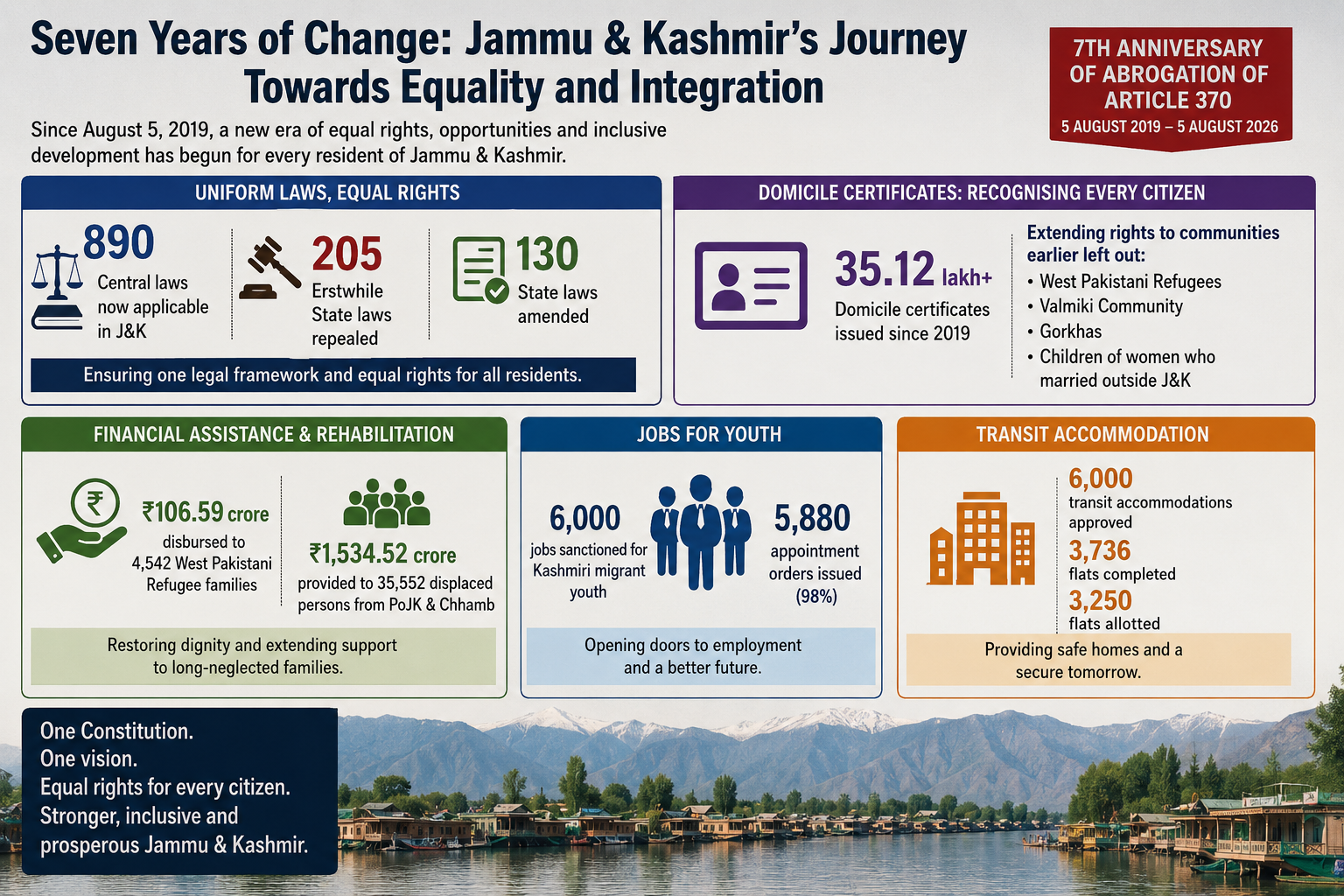
Seven years after the constitutional changes of August 5, 2019, the scale of legal integration is reflected not merely in constitutional language but in measurable outcomes. Official data show that 890 Central laws now operate in Jammu and Kashmir, replacing a fragmented legal framework in which 205 State laws were repealed and 130 amended. More than 35.12 lakh domicile certificates have been issued under the new rules, extending legal recognition to communities that had remained outside the ambit of equal rights for decades. The J&K Economic Survey 2025-26 further records that Rs. 106.59 crore has been disbursed among 4,542 West Pakistani Refugee families, while 35,552 displaced persons from PoJK and Chhamb have received assistance amounting to Rs. 1,534.52 crore. Simultaneously, 5,880 appointment orders have been issued against 6,000 sanctioned jobs for Kashmiri migrant youth, alongside the completion of 3,736 transit accommodation flats. Together, these figures illustrate the breadth of constitutional integration and the extension of welfare and legal entitlements across previously excluded sections of society.
The importance of these developments extends beyond individual beneficiaries. Equality under law is not merely about granting benefits; it is about removing structural barriers that prevent citizens from realizing their potential. A society where legal rights depend upon one’s birth, ancestry, or inherited status inevitably breeds alienation. When constitutional guarantees become universal, citizens increasingly view institutions as instruments of justice rather than exclusion.
The principle of equality has always occupied a central place within the Indian Constitution. Articles guaranteeing equality before law, prohibition of discrimination, equality of opportunity in public employment, and protection of life and liberty collectively establish that citizenship cannot be fragmented into multiple tiers. The constitutional changes of August 2019 were presented as an effort to harmonize Jammu and Kashmir with these foundational principles by ensuring that the same legal standards applied uniformly throughout the country.
Critics of the constitutional changes continue to raise important political, historical, and federal concerns regarding the manner in which Article 370 was abrogated. These debates remain part of India’s democratic discourse and deserve thoughtful engagement. However, viewed specifically through the prism of social equality, the constitutional restructuring sought to address longstanding disparities that had affected women, marginalized communities, refugees, disadvantaged castes, and several other groups whose rights had remained limited under the earlier framework.
The transformation has also carried symbolic significance. Laws possess not only legal force but also moral authority. When citizens perceive that the law treats everyone equally, public confidence in institutions tends to strengthen. Equality before law reinforces national unity because it assures every individual that rights are not privileges reserved for select groups but guarantees available to all.
The experience of Jammu and Kashmir demonstrates that constitutional reform is meaningful only when it improves the everyday lives of ordinary people. Access to education, employment, housing, healthcare, local governance, and welfare represents the true measure of constitutional success. Legal equality acquires real significance when it enables a sanitation worker’s child to aspire to civil services, when a refugee family gains access to higher education, when a woman enjoys equal inheritance rights, and when rural communities participate meaningfully in governance through empowered local institutions.
As India marks another anniversary of August 5, the debate surrounding Article 370 will undoubtedly continue in political and constitutional forums. Yet beyond competing narratives lies a broader human question: should any citizen be denied equal rights because of birth, gender, caste, ancestry, or historical circumstance? The philosophy of constitutional democracy answers that question unequivocally in the negative.
From this perspective, the abrogation of Article 370 represented more than the repeal of a constitutional provision. It marked the dismantling of legal distinctions that many regarded as inconsistent with the principle of equal citizenship. For numerous women, marginalized communities, refugees, disadvantaged castes, and rural institutions, it signified the restoration of constitutional rights that had long remained beyond their reach.
Ultimately, the strength of a democracy is measured not by the privileges it grants to a few but by the justice it guarantees to all. Social equality remains the bedrock upon which inclusive development, human dignity, and national unity are built. Whatever political interpretations history may ultimately assign to August 5, 2019, its enduring legacy will continue to be evaluated by one fundamental standard: whether it brought the promise of equal rights and equal opportunity closer to every citizen of Jammu and Kashmir.