Onlykashmir.in News Desk
Srinagar: Jammu and Kashmir observed Partition Horrors Remembrance Day on August 14 with programmes across several districts, commemorating the victims of the 1947 Partition, recalling the suffering and displacement of millions, and reaffirming the imperative of peace, social harmony and national unity.
At a function at Tagore Hall, Srinagar, Lieutenant Governor Manoj Sinha paid homage to those who endured the trauma of Partition and said its wounds continued to remain embedded in the collective consciousness of India. He described remembrance as a moral responsibility towards the victims and urged people, particularly the youth, to draw lessons from history, reject communal bitterness and build bridges of trust.
The Lieutenant Governor said the Partition separated families and displaced communities from Pakistan-occupied Jammu and Kashmir and Chhamb. He also paid tribute to those who, he said, faced discrimination for decades within the Union Territory because of Article 370, asserting that Prime Minister Narendra Modi had brought an end to their deprivation by extending equal rights to them.
Recalling the tribal invasion of Jammu and Kashmir shortly after Partition, Manoj Sinha paid tribute to the Indian Army and the families who suffered immense losses while displaying courage, resilience and unwavering patriotism. He emphasised that India’s strength lies in its diversity and called upon the younger generation to ensure that the tragedies of the past are never repeated.
The programme was attended by Chairperson Jammu and Kashmir Waqf Board Dr. Syed Darakhshan Andrabi, Chief Secretary Atul Dolo, Additional Chief Secretary Jal Shakti Department Shalin Kabra, Principal Secretary Culture Bridge Mohan Sharma, BJP Jammu and Kashmir General Secretary (Organization) Ashok Kaul, senior officials, prominent citizens and a large number of youth. A photo exhibition was held, a two-minute silence was observed in memory of Partition victims, and artists presented a theatrical depiction of the trauma, displacement and hardships endured by millions.
In Jammu province, the Indira Gandhi National Centre for the Arts (IGNCA) Regional Centre Jammu and Kashmir, in collaboration with the District Administration Rajouri, organised a symposium titled “Remembering the Horrors of Partition.” The programme focused on preserving the testimonies and memories of families affected by forced migration and displacement from Pakistan-occupied Jammu and Kashmir in 1947 and 1965.
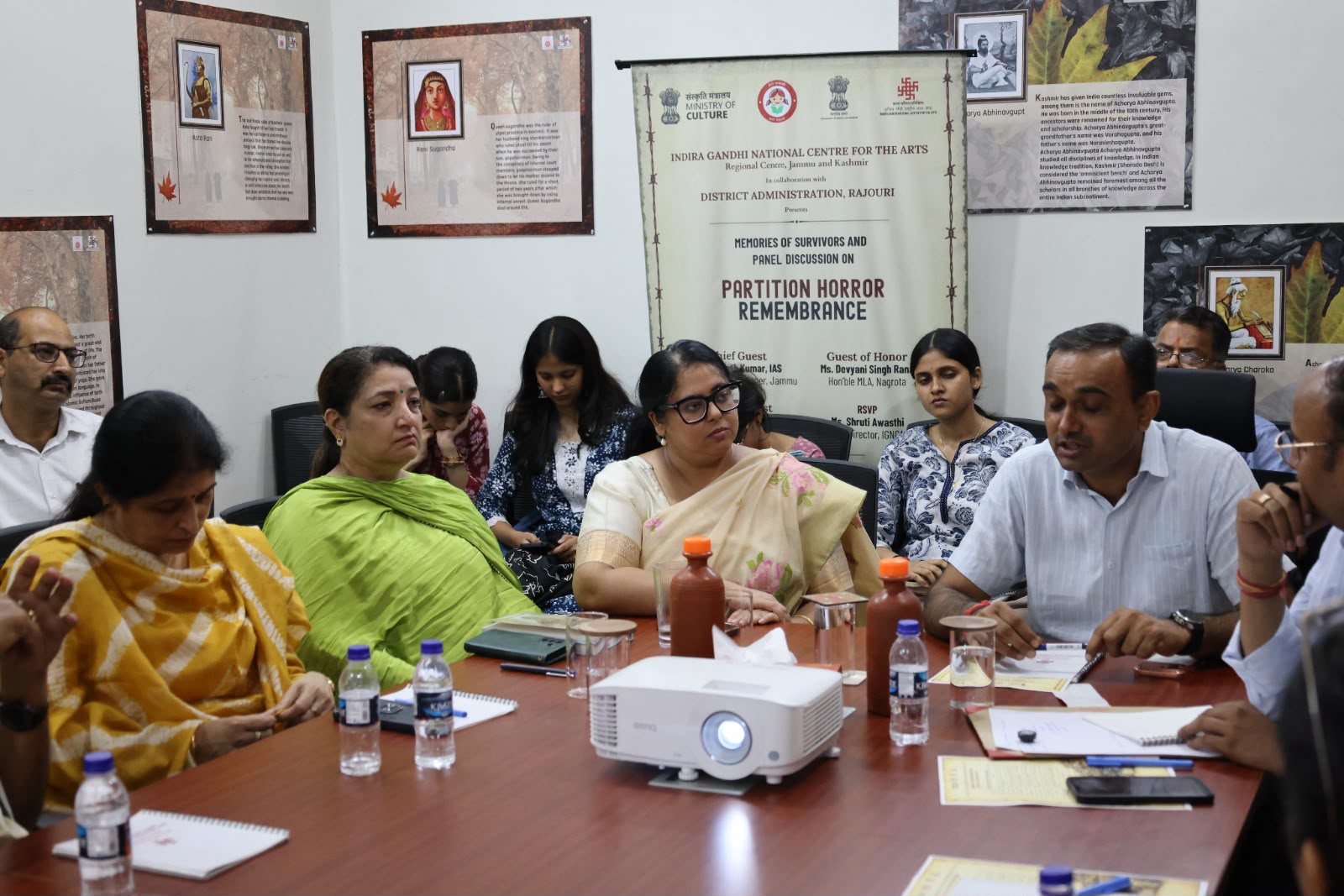
Divisional Commissioner Jammu Ramesh Kumar praised the resilience of affected families, while Nagrota MLA Devyani Singh Rana, Vice Chancellor Baba Ghulam Shah Badshah University Rajouri Prof. Javed Iqbal, IGNCA Regional Director Shruti Awasthi and Rajouri Deputy Commissioner Abhishek Sharma participated in the proceedings. Abhishek Sharma also narrated his grandfather’s personal account of migration from Muzaffarabad.
Partition survivor and eyewitness Bakshi Raj, along with Dr. Madholika Singh, Prof. Sindhu Kapoor, Prof. Yashpal Sharma and Dr. Ajay Singh, shared historical perspectives and called for systematic documentation of oral histories relating to Partition, migration and the cultural heritage of Pakistan-occupied Jammu and Kashmir. A documentary on the Partition-era experiences of Muzaffarabad and Rajouri was also screened.
Similar commemorative programmes, including exhibitions, seminars, remembrance ceremonies, documentary screenings and discussions on Partition-era experiences, were organised in various districts of Jammu and Kashmir, bringing together survivors, researchers, officials, students and members of the public to preserve memories of one of the subcontinent’s most traumatic historical ruptures.
Background
Partition Horrors Remembrance Day is observed annually on August 14. The Government of India announced the observance in 2021, with Prime Minister Narendra Modi declaring that the day would commemorate the struggles and sacrifices of people affected by the Partition of 1947. The official rationale was not merely remembrance, but also to remind present and future generations of the human cost of hatred, violence, displacement and social division, while reinforcing the values of unity, social harmony and human dignity.
The 1947 Partition resulted in one of the largest episodes of mass displacement in modern history, accompanied by widespread communal violence, loss of life, separation of families and the destruction of homes and livelihoods. In Jammu and Kashmir, the legacy of Partition acquired an additional historical dimension through the displacement from areas including Muzaffarabad, Mirpur, Poonch and Chhamb, followed by the tribal invasion and armed conflict in 1947. The annual observance therefore carries particular resonance in the Union Territory, where memories of displacement and upheaval remain part of the lived histories of numerous families.
The observance is intended to transform remembrance into a civic commitment: to preserve historical memory without allowing the tragedies of the past to become a source of renewed hatred, and to strengthen the ideals of peace, fraternity, social cohesion and national unity.