Onlykashmir.in Desk
October 27, 1926, occupies a significant place in the history of Masjid al-Haram. It was on this day that a centuries-old practice of holding separate congregational prayers according to different schools of Islamic jurisprudence came to an end, with all worshippers brought together under one Imam.
The historic decision, which completed 100 years in 2026, transformed the prayer system at Islam’s holiest mosque and established a tradition that continues unchanged to this day.
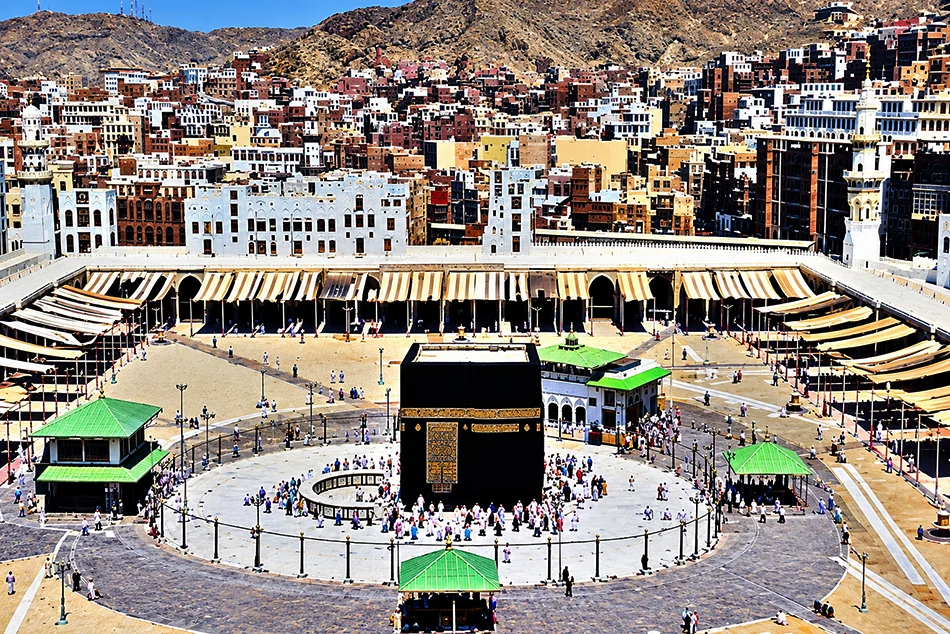 Historical accounts suggest that, before the reform, four separate prayer stations existed around the Holy Kaaba (As Shown in the above picture). Followers of the four Sunni schools of thought — Hanafi, Shafi’i, Maliki and Hanbali — gathered at their designated places and offered prayers behind their respective Imams. During much of this period, Makkah was governed by the Sharifian rulers (Sharifs of Makkah), who generally acknowledged Ottoman suzerainty, although the degree of Ottoman control varied over time.
Each congregation was held separately, one after another, meaning that the same obligatory prayer was performed several times a day within the Grand Mosque.
The practice continued for several centuries, reportedly emerging around the fourth and fifth centuries of the Hijri calendar and becoming firmly established in subsequent centuries. Travellers and historians who visited Makkah documented the arrangement in their accounts.
Among them was the renowned traveller Ibn Jubayr, who visited Makkah in 579 AH (1183–84 CE). In his travelogue, he recorded that the Shafi’i congregation usually prayed first, while followers of the other schools waited for their respective turns.
The sequence of the remaining congregations varied over different periods, but the system of separate prayers remained in place until the twentieth century.
Four prayer stations around the Kaaba
Historical records and archival images provide details of the four designated prayer stations, known as Maqams, which were located around the Holy Kaaba.
The Hanafi Maqam stood to the north of the Kaaba and was the largest among the four. It was also the only free-standing structure with two storeys.
The Maliki Maqam was situated to the west of the Kaaba, between the Yemeni and western corners. The Shafi’i Maqam occupied the upper level of the Zamzam well building on the eastern side, from where the chief muezzin also called the Adhan.
The Hanbali Maqam was located on the southern side of the Kaaba.
These separate stations symbolised the distinct arrangements for the four schools of thought, with each congregation following its own Imam.
King Abdulaziz’s historic decision
Following the establishment of his rule over the Hejaz, King Abdulaziz Al Saud initiated consultations with prominent Islamic scholars from the Hejaz and Najd to discuss the existing prayer arrangements at the Grand Mosque.
After deliberations, it was agreed on October 27, 1926, that all worshippers would offer prayers together behind one Imam, bringing an end to the system of separate congregations.
The four designated prayer stations were abolished, and a unified congregational system was introduced. Since then, only one congregation has been held for each obligatory prayer at Masjid al-Haram.
The decision was more than an administrative reform. It became a powerful symbol of Muslim unity, brotherhood and collective worship, bringing people together irrespective of their language, nationality or school of jurisprudence.
It also restored the practice of a single congregation behind one Imam, reflecting the established model of collective prayer during the time of Prophet Muhammad (peace be upon him) and his companions.
A century of unity under one congregation
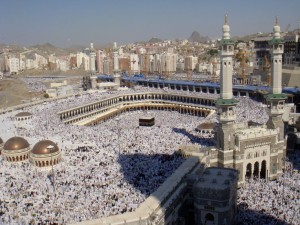 Today, millions of Muslims from across the world gather at Masjid al-Haram to offer prayers in unbroken, united rows behind a single Imam.
Although several qualified Imams serve at the Grand Mosque and take turns leading the prayers, each obligatory prayer is conducted as one congregation, without separate groups or parallel prayer stations.
A century after the historic decision, the system remains intact, reflecting the enduring significance of unity and equality in Islamic worship.
The completion of 100 years of prayers under one Imam at Masjid al-Haram is therefore not merely a historical milestone. It is also a reminder of the spirit of brotherhood and collective devotion that brings Muslims from every corner of the world together around the Holy Kaaba.