Rameez Makhdoomi
Daily Srinagar Jang & Only Kashmir
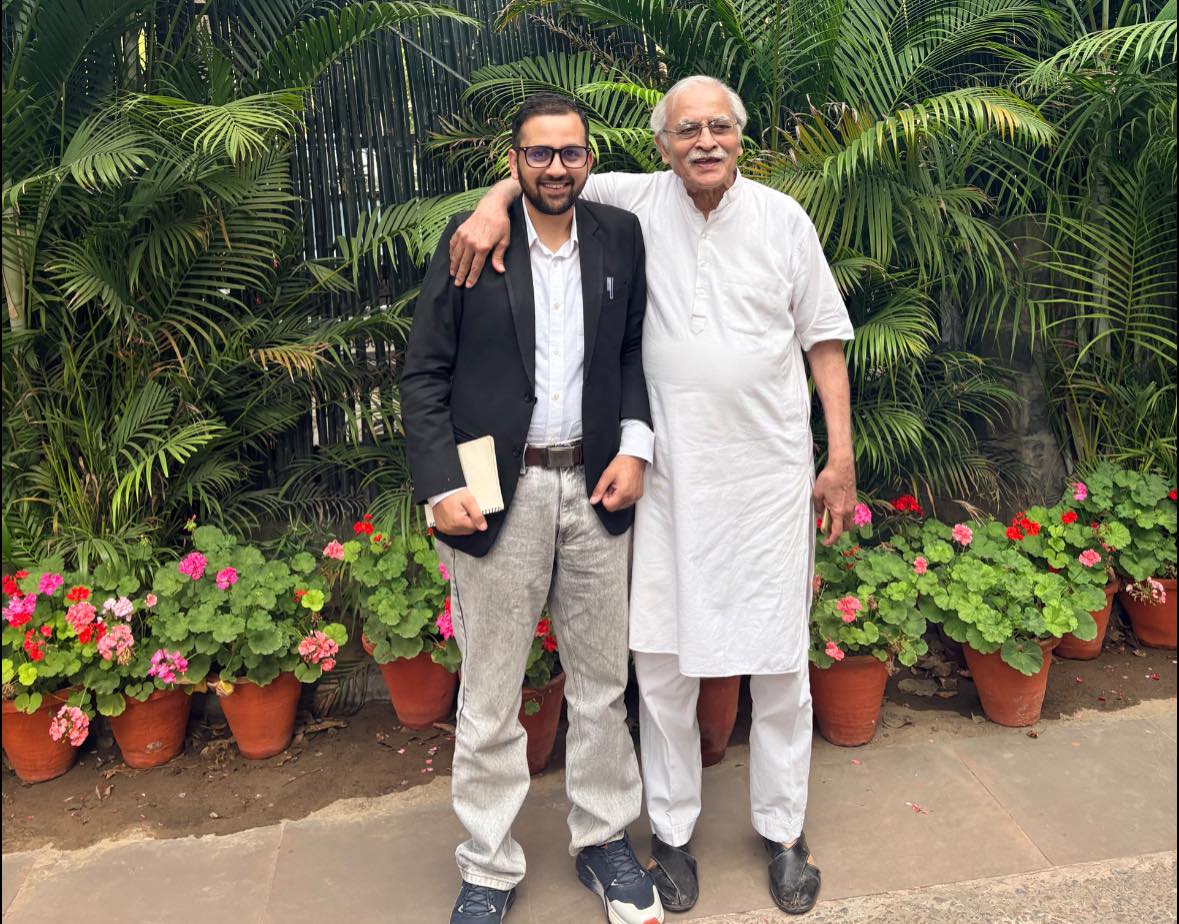
In a world searching for sustainable and ethical alternatives, the idea of Swaraj, rooted in self-restraint, dignity, and harmony, may offer more than just nostalgia. It may offer a way forward. In this exclusive and wide-ranging conversation, Rajiv Vora, head of Swaraj Peeth and a prominent Gandhian thinker, reflects on modernity, non-violence, Kashmir, self-reliance, and the deeper question of Indian identity.
Here are the excerpts of the conversation in the form of Questions and Answers.
Rameez Makhdoomi: Let me begin with a foundational question. In today’s modern age, Gandhi emphasized simplicity and self-sufficiency. How do we reconcile modernity with Gandhian ideals?
Rajiv Vora: Before I answer your question, let me ask you a question in return. Can milk and poison ever mix? If you combine them, what will you get?
This is the contradiction we are living in. What we call modernity today is fundamentally in conflict with nature and, in a deeper sense, with the divine order. Tell me honestly, can you call yourself modern without being hostile to nature?
Look at the last 70 years. Has the air improved or become poisonous? In cities like Delhi, people are running away because they cannot breathe. Oxygen machines are now kept inside homes. Thirty years ago, between Delhi and Chandigarh, there was just one cancer hospital. Today, there are dozens.
We are eating food, but is it pure? No. The air is toxic, the water is toxic, the soil is poisoned. Every household now needs machines to purify water. The earth itself has been contaminated.
So, Gandhi ji opposed not modernity as a concept, but a destructive modernity that thrives on the exploitation of nature and human beings.
Rameez Makhdoomi: Then why do we see a growing trend toward organic food and sustainable living today?
Rajiv Vora: Because people are slowly realizing the damage. When you go to the market today, everything says “organic.” Why? Because the normal system of production cannot function without poisoning the land, water, and air.
It cannot operate without destroying forests or exploiting weaker sections of society. That is why organic has become valuable, because purity has become rare.
This so-called scientific modern production is dependent on destruction. That is the crisis.
Rameez Makhdoomi: You also touched on the philosophical roots of modernity. Could you explain how this conflict began historically?
Rajiv Vora: Modernity emerged from a specific European crisis. During the Enlightenment, the Church had become oppressive. It dictated truth and suppressed questioning. Scientists like Galileo challenged this by saying the Earth revolves around the sun.
The Church punished them because it claimed authority over truth. So modern science emerged by rejecting religious authority and saying that only what we perceive through our senses is true.
But this conflict between religion and reason was specific to Christianity at that time. It was not the same in traditions like Hinduism or Islam.
The problem is that this reaction created a model of modernity that excluded deeper spiritual understanding and harmony with existence.
Rameez Makhdoomi: Let’s move to global conflicts. With wars and violence increasing, how can Gandhian non-violence be applied today?
Rajiv Vora: Non-violence cannot simply be declared. It requires preparation and investment.
If a disease spreads and you eliminate all doctors, can amateurs cure it? Similarly, if you neglect people who practice non-violence, how will society produce peace?
Today, every country invests in weapons, armies, and war strategies. But where is the investment in non-violence?
At Swaraj Peeth, we experimented in places like Bihar and Jharkhand. People who once believed in armed struggle, Maoists, ideological extremists, even caste-based violent groups, transformed.
In some areas, former Maoist commanders have been leading non-violent marches for over a decade. Violence disappeared from those regions, not because we forced them into a “mainstream,” but because we respected their identity and created a shared path.
There is no single mainstream. Everyone has their own stream. Together, they form a river. That is the idea.
Rameez Makhdoomi: You also mentioned that society today is drifting away from principles. Could you elaborate?
Rajiv Vora: Yes. Today, life is driven by self-interest. People no longer ask: ” What is my duty? What about my community?
We live what is called a contingent life, reacting to situations without long-term vision or principles. Every day is about survival, earning, managing, competing.
In such a life, where is the space for non-violence or ethics? If society does not invest in values, it will naturally produce conflict.
Rameez Makhdoomi: Coming to Jammu and Kashmir, since you have worked a lot in Kashmir Pre-Abrogation of Article 370, I, along with my Editor, Mr. Bilal Bashir Bhat, and others, have closely worked with you on Kashmir. How do you view the changes post Abrogation under Lieutenant Governor Manoj Sinha?
Rajiv Vora: I felt satisfied when they appoint Manoj Sinha as Lieutenant Governor of Jammu and Kashmir. Otherwise, the army guys and bureaucrats were the ones sent to manage Kashmir.
You know, they were sent there to run things, but Manoj Sinha didn’t go there just to manage Kashmir—that’s the impression I got from how he behaved. I thought, well, if this gives some relief to the people of Kashmir, that’s really important, because they haven’t had any breathing space for a long time. They’re completely exhausted, whether it’s the state or the army. Whether it’s the religious leaders there, or their communal leaders, or the ideological folks, they all kept these people scared. They kept them intimidated. Even the political parties have kept them scared. The party in power scares them through the central government of India. And when that same party is in opposition, it scares others. Kashmir had become a game of fear.
Since Manoj ji has been a youth leader, his upbringing and ideological grooming—whether from the BJP or the RSS, which I don’t fully agree with—I acknowledge the influence of the RSS. I’m not aligned with that ideology, but every ideology has its own place. So there’s a place too. We have to acknowledge that, right? Because this is democracy. If we believe in democracy, then we’ll make space for Congress, BJP, the Sangh, and other organizations as well.
But if you bring violence and create divisions among people, then you’re wrong. They’ve tried to reduce the gaps between people in Kashmir. I felt that the biggest need for Kashmir was that those in power there… The common people feel closer to them now because the biggest way to tackle fear, the solution to it, if anyone has it, it’s only those in power, right? So whatever efforts they’ve made, they’ve made good and sincere efforts.
From what little I know and understand, that’s the experience I’ve had. You explained about Jammu and Kashmir, and even my friends there who are otherwise against BJP, they still praise Manoj Sinha. That’s what you explained about Jammu and Kashmir.
Manoj Sinha had this program on October 2 that lasted for 3 years, where teachers in Kashmir’s schools made some small skits. They showed how Kashmir was self-reliant. They talked about “ghani” — you know, the thing used to extract oil. And look at what’s happening with oil today. If you go to the market to buy oil, you’ll find there’s one kind called… what’s it called? Press oil, wooden press oil. How much does that cost?
Rameez Makhdoomi: Let’s return to Gandhi’s idea of self-reliance. Can a village-based self-reliant economy survive in today’s globalized world?
Rajiv Vora: It must survive, otherwise society will collapse. Self-reliance is directly connected to human dignity.
If your life depends entirely on someone else, they can control you. And when control comes, dignity is lost.
Earlier, villages produced their own needs through small industries. But industrial policies shifted these to large corporations. Even basic goods like oil, spices, and daily essentials are now controlled by big industry.
Let me give an example. Traditional “ghani” oil, cold-pressed oil, was once locally produced. Today, refined oil sells cheaper, but the same traditional oil now costs much more because it is rare.
This shows the potential we destroyed in the name of industrialization. People who were once self-reliant became dependent and economically weak.
Rameez Makhdoomi: You make a strong link between self-reliance and character. Could you expand on that?
Rajiv Vora: Yes. A person without self-reliance cannot have character. If someone else controls your survival, your decisions are no longer yours.
Gandhi ji believed that losing self-reliance is losing dignity, and losing dignity is like losing the presence of God in your life.
Rameez Makhdoomi: A sensitive question now. The glorification of Nathuram Godse on social media is troubling many. What would you say to those promoting such ideas?
Rajiv Vora: I feel ashamed even addressing it. I have spoken for decades, and some have listened, but this trend will fade on its own.
India’s civilization is deeply rooted in moral values. Such tendencies are temporary.
The best response is complete ignorance. Do not debate them, do not amplify them. Ignoring them is the strongest way to erase their relevance.
Rameez Makhdoomi: Finally, your upcoming Book raises a profound question: Who is an Indian?
Rajiv Vora: Swaraj is what Indian identity is, it’s living for Swaraj, and having Swaraj within. Not tradition, but today there’s no self-rule; still, whoever believes in self-rule, whoever fights for it, whoever pushes it forward—I’d say this book calls those people Indian who rejected the idea of self-rule. And after Gandhi ji passed away, it was rejected even more; in fact, it was rejected during Gandhi ji’s lifetime itself.
When Gandhi ji wrote to Jawaharlal Nehru that freedom is coming, he said you all should think about the concept of Hind Swaraj. Nehru made it clear he was with Gandhi because he was a great fighter, not for the idea itself. You were a great thinker, and your idea of self-rule. But self-rule was never really good in India, and we never wanted it to come back. This was clearly written to Gandhi ji, and after that, the materialists of this country suppressed all these things.
This country was badly betrayed—the whole conflict between the two Indias, and how, from a Western perspective, India was interpreted, and how the West wanted to shape India according to their ideal, that ideal which was meant for India’s reconstruction and rebuilding. Politics made its own power, its own constitution, everything.
They created an image of India that we’re supposed to follow. Today, we’re fighting among ourselves, while just yesterday people were living comfortably; now they’re out on the streets, in the slums. Whether that happened or not, that’s the image we’re suffering from.
And then there was Gandhi’s image, where the people stood with him—that was the real tradition of India. But that image was rejected, and Swaraj was rejected. So, how can we call those who rejected Swaraj true Indians?
Rameez Makhdoomi: Thank you, Rajiv ji, for this deeply insightful and thought-provoking conversation.
(END)
VIDEO OF THE CONVERSATION